Make-believe media : the politics of film and television by Michael Parenti
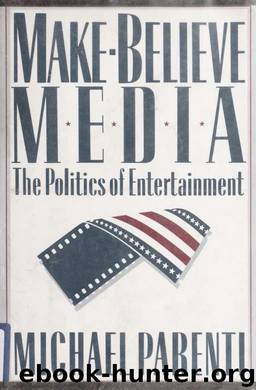
Author:Michael Parenti
Language: eng
Format: epub
Tags: General, Mass Media - Electronics Media, Performing Arts (Specific Aspects), Politics - Current Events, Influence, Motion pictures, Political aspects, Television Broadcasting, Television and politics, United States, Sociology, Television broadcasting, Social values
Publisher: New York : St. Martin's Press
Published: 1992-03-10T16:00:00+00:00
A number of movies appearing in the 1970s and 1980s featured rogue cops like Clint Eastwood's Dirty Harry (1971), and its sequels. Magnum Force (1973), The Enforcer (1976), Sudden Impact (1983), and The Dead Pool (1988). Like their television counterparts, such films reaffirm the views of right-wing police organizations and politicians, who see the law as “handcuffing” the police. Dirty Harry argues that the law is guilty of protecting the rights of a homicidal psychopath. In real life, however, “the majority of suspects are poor, inarticulate and ignorant petty criminals open to police bamboozlement.”12 Detective Harry's angry remarks to his superior sound like D'Angelo's: “[What about the rights] of that old lady who had a sawed-off shotgun in her ear. Or doesn't she count anymore? What the hell is going on around here? ... We're more concerned with the rights of the criminals than of the people we're supposed to be protecting.”13 This charge was to be made relentlessly in real life and with great effect by conservative politicians for years on end.
The authoritarian message comes through again and again: The law does not protect you; it hinders those who wish to protect you. Only severely repressive direct action by persons freed from the manacles of the law can prevent the social order from falling apart. It is a mistake to describe such offerings as “law-and-order” shows. If anything is being boosted, it is lawlessness perpetrated by self-appointed vigilante cops.
TV Doesn’t Help Real Cops
Captain Thomas Gallagher, com-mander of the 44th Precinct in the Bronx, N.Y., offered this observation about police work and television:
Unlike TV policemen, we don’t always come up with the bad guy. We have a lot of restrictions, many of them constitutional. Some TV viewers feel we’re not as good as Kojak, that we’re not doing the proper job because we don’t get our man in an hour. So TV doesn’t help us in that regard. Nor does it help us when so many illegal acts are performed by TV police. ...
I realize there’s right-wing pressure on the Supreme Court to crack down on offenders. The public seems to feel there’s too much crime and that we have to wipe the criminals off the street, regardless of their constitutional rights. Television picks up on this.
Interview in Saturday Review, March 19, 1977
Download
This site does not store any files on its server. We only index and link to content provided by other sites. Please contact the content providers to delete copyright contents if any and email us, we'll remove relevant links or contents immediately.
The Art of Coaching Workbook by Elena Aguilar(51134)
Trainspotting by Irvine Welsh(21606)
Twilight of the Idols With the Antichrist and Ecce Homo by Friedrich Nietzsche(18599)
Fangirl by Rainbow Rowell(9208)
Periodization Training for Sports by Tudor Bompa(8236)
Change Your Questions, Change Your Life by Marilee Adams(7715)
This Is How You Lose Her by Junot Diaz(6854)
Asking the Right Questions: A Guide to Critical Thinking by M. Neil Browne & Stuart M. Keeley(5734)
Grit by Angela Duckworth(5574)
Red Sparrow by Jason Matthews(5446)
Paper Towns by Green John(5157)
Room 212 by Kate Stewart(5087)
Ken Follett - World without end by Ken Follett(4701)
Housekeeping by Marilynne Robinson(4418)
The Sports Rules Book by Human Kinetics(4365)
Double Down (Diary of a Wimpy Kid Book 11) by Jeff Kinney(4252)
Papillon (English) by Henri Charrière(4235)
The Motorcycle Diaries by Ernesto Che Guevara(4069)
Exercise Technique Manual for Resistance Training by National Strength & Conditioning Association(4048)
